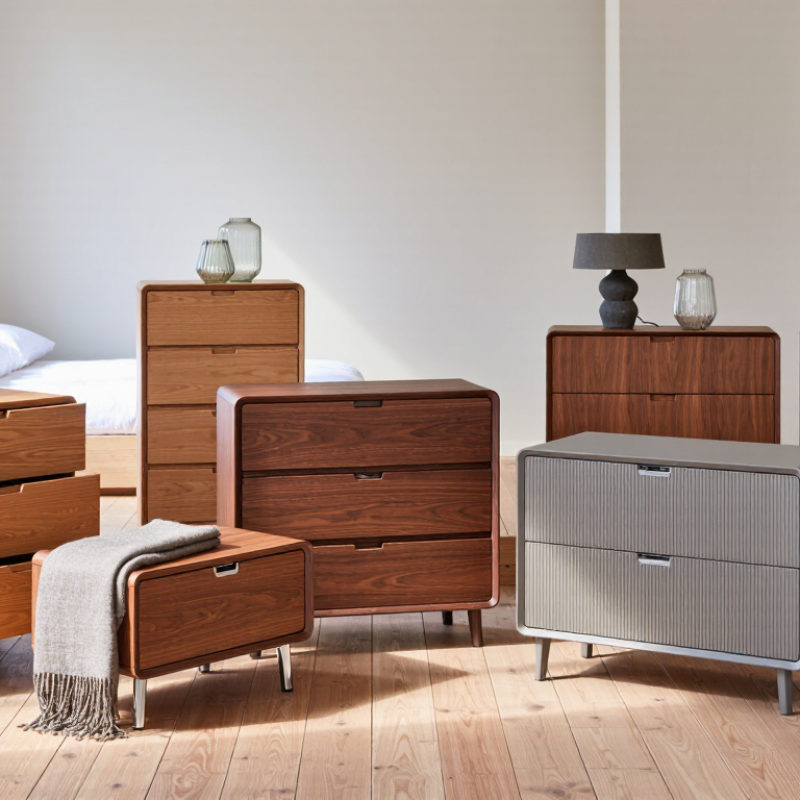
The 2026 furniture market is moving toward quieter luxury, smarter storage, and more adaptable living spaces. Modern Dressers are no longer simple bedroom cabinets. They are becoming visual anchors for bedrooms, dressing areas, hospitality rooms, and compact urban apartments.
Global buyers are watching several practical shifts. Soft, rounded edges are replacing severe geometric forms. Warm oak, smoked walnut, recycled metal, and textured laminates are gaining attention. Matte surfaces look refined, but they can reveal fingerprints under strong showroom lighting. That detail matters in everyday use. Buyers also want deeper drawers, concealed cable management, adjustable legs, and stronger runners. These features support real homes, not only catalog photography.
Interior designer Kelly Wearstler has said, “Design is about the experience.” Her observation explains why appearance alone cannot define the next generation of Modern Dressers. A successful piece should feel stable when opened, operate quietly, and arrive safely across long supply routes. Manufacturers must also provide clear dimensions, material information, testing records, and responsible sourcing evidence. These details help importers, retailers, and homeowners make more reliable decisions.
Some 2026 predictions may age badly. Trends often move faster than production schedules. A dramatic fluted front may attract attention today, yet appear dated tomorrow. Buyers should compare visual appeal with repairability, packaging quality, and long-term comfort. This guide examines the strongest Modern Dressers trends for global buyers, while questioning which styles offer genuine value beyond the showroom.
The 2026 modern dresser market should be read through trade evidence, not showroom impressions. UN Comtrade HS 9403 data offers a useful view of furniture flows between major exporting and importing economies. However, HS 9403 covers more than dressers, including various furniture categories. This classification gap needs careful attention.
Trade Data
Global buyers can compare annual import values, quantities, trade partners, and calculated unit values. A rising unit value may reflect better materials, larger storage capacity, freight changes, or currency movement. It does not automatically prove stronger design demand. Data matters. Buyers should check several years, not one unusual result.
Current sourcing discussions Current sourcing discussions often focus on modular drawers, compact silhouettes, rounded corners, and mixed wood-and-metal finishes. These features fit smaller urban bedrooms and flexible rental spaces. Yet trade data cannot confirm whether a specific trend caused higher imports. Customs records may also differ in timing and product descriptions. I would compare HS 9403 results with supplier audits, product samples, and retail observations. A clean ranking can still mislead. For practical decisions, buyers should review moisture resistance, drawer testing, packaging strength, and responsible material documentation before placing orders. A beautiful dresser with weak edge protection may arrive damaged after a long ocean journey. That risk rarely appears in trade statistics.
2026 Top Modern Dresser Trends for Global Buyers
Houzz survey data on storage preferences shows a clear demand for furniture that reduces clutter. Buyers want more usable space without making rooms feel crowded. Modern dressers are responding with deeper drawers, vertical profiles, and flexible compartments. A six-drawer unit may replace several smaller storage pieces. That change can improve bedroom movement, especially in compact apartments.
Practical details now matter as much as appearance. Smooth drawer runners, strong handles, and easy-clean surfaces support everyday use. Buyers should check internal drawer dimensions, not only exterior measurements. A drawer that looks deep may lose space through thick panels or poor hardware. Light finishes can brighten a narrow room, while darker wood tones add visual weight. The perfect dresser does not exist. A space-saving design may still feel awkward beside a large bed. Safety features, stable construction, and compliance with local furniture standards should remain essential purchasing criteria.
Tips: Measure the wall, walkway, and door clearance before ordering. Leave enough room for fully opened drawers. Choose modular storage when household needs may change. Ask for material details, load limits, care instructions, and assembly guidance. Review product measurements twice. Mistakes often happen there. Global buyers should also confirm packaging strength, delivery conditions, and replacement-part support before purchase.
Euromonitor market analysis points to modular and sustainable furniture as important forces shaping 2026 dresser purchases. Global buyers increasingly want storage that adapts to smaller rooms, changing households, and varied retail formats. A modular dresser can add drawers, change its layout, or move between rooms. That flexibility reduces replacement pressure. It also supports practical design.
Materials now receive closer attention. Buyers may look for recycled panels, responsibly sourced timber, water-based finishes, and easily separated hardware. A dresser with replaceable drawer runners can stay useful longer. Flat-pack construction can reduce shipping volume, but only when packaging is efficient. Otherwise, sustainability claims become less convincing.
Details matter. Check material disclosures, durability testing, repair instructions, and supplier documentation. Euromonitor’s wider consumer research suggests that environmental concern is growing, yet price remains influential across many markets. Buyers therefore need measurable value, not attractive language alone. Modular products may cost more initially. They can still reduce long-term waste when parts remain available.
The market is not perfectly green. Recycled materials may have inconsistent textures. Assembly can frustrate users. Some modular systems also use extra connectors and packaging. These weaknesses deserve honest review. A better 2026 dresser should balance adaptable storage, stable construction, responsible sourcing, and straightforward maintenance. Good design is not only about appearance. It should work on a busy weekday, survive repeated opening, and remain useful after a room changes.
Macro signals supporting modular, space-efficient and sustainable furniture design
The chart combines two measurable market signals: the rising share of people living in urban areas, which supports compact and modular storage solutions, and the EU circular material use rate, which reflects the broader shift toward recycled inputs, repairability and longer product lifecycles. Urban population figures are UN projections; circular material use figures are reported by Eurostat.
Sources: United Nations, World Urbanization Prospects; Eurostat, Circular Material Use Rate.
Modern dressers are moving toward lighter wood tones, low-emission panels, and traceable materials. FSC’s 2023 Facts & Figures report records more than 160 million hectares of certified forest worldwide. For buyers, FSC certification supports responsible sourcing, but it does not automatically prove product safety. Check the certificate scope, validity, and chain-of-custody details.
Safety begins with panel testing. CARB Phase 2 limits formaldehyde emissions to 0.05 ppm for hardwood plywood, 0.09 ppm for particleboard, and 0.11 ppm for medium-density fiberboard. These limits are also referenced by the U.S. EPA’s TSCA Title VI program. Ask suppliers for current laboratory reports, not only compliance claims. Test reports should identify the exact board grade and production date.
E1 uses an emission limit of 0.124 mg/m³ under the EN 717-1 chamber method. Small differences in test methods can create confusing comparisons. Be careful here. A dresser may meet E1 but lack CARB documentation, or carry FSC wood without low-emission verification. Inspect edge sealing, drawer interiors, screw joints, and packaging odors during sampling. Industry data often looks precise, yet factory variation remains a practical weakness. Independent retesting before shipment is expensive, but one failed container can cost more.
2026 Top Modern Dresser Trends for Global Buyers
Global Sourcing: MOQ, Lead Time, Pricing, and ISTA 3A Test Data
Modern dressers are moving toward clean profiles, softer corners, and flexible storage. Global buyers should confirm specifications before discussing price. A typical MOQ may range from 100 to 500 units, depending on materials, finishes, and factory capacity. Custom colors often require a higher threshold. Small orders can raise unit costs sharply.
Lead time needs a written production schedule. Sample approval may take 7 to 15 days. Bulk production can require 35 to 60 days after deposit and final approval. Add time for packaging, inspection, and ocean booking. I have learned that “ready to ship” sometimes excludes hardware checks. That wording needs clarification.
Pricing should show the cabinet, fittings, packaging, labor, testing, and delivery terms separately. Ask whether replacement parts are included. Request an ISTA 3A test report for the exact packaged dresser, not a similar model. The report should identify package weight, dimensions, test sequence, damage findings, and photographs. Drop, vibration, and compression results can change with packaging design. One extra foam layer may protect a corner but increase freight cost. Trade-offs are real. Buyers should review carton compression strength and internal movement before approving mass production. A third-party inspection can verify dimensions, finish consistency, drawer operation, and carton labels. Test data helps, but it does not replace judgment.
Indicative 2026 sourcing benchmarks for export-ready modern dressers. Prices are estimated FOB Asia per unit in USD, excluding duties, inland delivery, and destination charges.
| Trend / Product Positioning | Product Specifications | Global Sourcing Benchmarks | ISTA 3A Packaging Validation | |||||||
|---|---|---|---|---|---|---|---|---|---|---|
| Typical Size (W × D × H) |
Core Construction | Finish Direction | Key Buyer Segment | Indicative FOB Price | MOQ | Production Lead Time | Typical Packed Gross Weight | Recommended Test Scope | Acceptance Data to Record | |
|
Warm Minimalist Fluted Dresser
Vertical ribbed fronts, soft edges, and natural wood tones.
|
1,600 × 450 × 800 mm | CARB Phase 2 or E1 MDF, plywood case, solid-wood legs, metal drawer runners | Oak-look veneer or wood-grain foil; low-sheen clear coat | Apartment, bedroom, and lifestyle furniture programs | US$128–178 | 100–200 units | 35–50 days | 48–62 kg | One fully packaged unit; current ISTA 3A atmospheric conditioning, handling, shock/drop, vibration, and compression sequence based on actual package weight and dimensions. | Record package dimensions, gross weight, visible damage, drawer operation, frame squareness, hardware retention, and photographs before and after testing. |
|
Japandi Low-Profile Dresser
Horizontal proportions, recessed pulls, and restrained detailing.
|
1,800 × 450 × 680 mm | Engineered wood, veneered panels, solid-wood or steel support base | Light ash, natural oak, mushroom, or warm white matte finish | Premium residential and small-space interiors | US$145–205 | 80–150 units | 40–55 days | 52–68 kg | Use a representative export package and apply the current ISTA 3A schedule for its gross-weight category; include edge, corner, and face-impact exposure. | Pass criteria should include no cabinet separation, no broken legs, no panel cracks, smooth drawer travel, and no cosmetic damage visible at normal viewing distance. |
|
Soft-Curved Contemporary Dresser
Rounded corners and curved drawer faces for a softer modern silhouette.
|
1,500 × 450 × 780 mm | Formed MDF or plywood, reinforced carcass, concealed metal hardware | Warm grey, clay, sand, or satin lacquer with low-gloss sheen | Design-led e-commerce and boutique residential projects | US$155–225 | 100–200 units | 45–60 days | 46–60 kg | Test the production-intent package under ISTA 3A conditions, with special attention to curved front panels and corner protection. | Record impact marks, coating damage, drawer-front alignment, corner radius integrity, fastener loosening, and post-test functional performance. |
|
Modern Cane-Panel Dresser
Natural woven inserts combined with clean-lined storage modules.
|
1,600 × 420 × 800 mm | MDF or plywood carcass, natural cane or paper-cane panel, metal runners | Natural cane with walnut, medium oak, or black stained frame | Bohemian-modern, resort, and hospitality-inspired collections | US$135–195 | 100–250 units | 40–55 days | 45–58 kg | Include ISTA 3A shock and vibration exposure with additional protection against puncture, abrasion, and localized compression of cane panels. | Inspect cane weave continuity, frame joints, panel seating, moisture-related deformation, surface abrasion, and drawer operation after testing. |
|
Two-Tone Monochrome Dresser
Contrasting body and drawer colors for a graphic, contemporary appearance.
|
1,400 × 450 × 760 mm | Engineered wood, powder-coated steel legs, soft-close or standard metal runners | Black and oak, white and walnut, or charcoal and natural wood | Mid-market online retail and coordinated bedroom ranges | US$105–158 | 150–300 units | 30–45 days | 40–54 kg | Validate the packed product under the applicable ISTA 3A sequence and check color-finish protection after vibration and repeated handling. | Record scuffing, color transfer, paint chips, leg stability, drawer-face alignment, hardware migration, and carton deformation. |
|
Tall Vertical Storage Dresser
Space-efficient six- or seven-drawer format for compact rooms.
|
800 × 450 × 1,200 mm | Engineered wood carcass, anti-tip hardware, metal drawer slides | White, light oak, walnut, or muted green matte finish | Urban housing, student accommodation, and compact bedrooms | US$118–172 | 100–250 units | 35–50 days | 50–70 kg | Use an ISTA 3A package representative of the tallest configuration; evaluate stability, vertical compression, vibration, and corner impacts. | Record cabinet lean, base distortion, anti-tip component condition, drawer retention, structural joint movement, and package compression loss. |
|
Modular Configurable Dresser
Stackable or combinable modules supporting multiple room layouts.
|
1,200–1,800 × 400–450 × 700–800 mm | Knock-down engineered wood panels, connector fittings, adjustable feet | Natural wood tones, matte neutrals, or mix-and-match modular colors | Multi-SKU retail programs and international private-label collections | US$92–168 | 200–500 units | 30–45 days | 35–60 kg per module | Test each module configuration separately when package size or gross weight changes; apply current ISTA 3A conditioning, drop, vibration, and compression requirements. | Record connector integrity, panel edge damage, assembly fit, dimensional change, missing components, and reassembly success after testing. |
|
Premium Natural-Wood Accent Dresser
Higher-value design with visible grain, refined joinery, and durable hardware.
|
1,600 × 480 × 820 mm | Solid wood components with veneered engineered-wood panels and metal hardware | Natural walnut, smoked oak, or clear-finished ash; hand-rubbed appearance | Premium residential, hospitality, and design-oriented projects | US$220–360 | 50–100 units | 55–75 days | 58–78 kg | Conduct ISTA 3A validation on the final export pack, including reinforced corner protection and surface isolation for visible wood components. | Record joint opening, veneer or solid-wood dents, finish gloss change, hardware loosening, drawer alignment, and structural functionality. |